
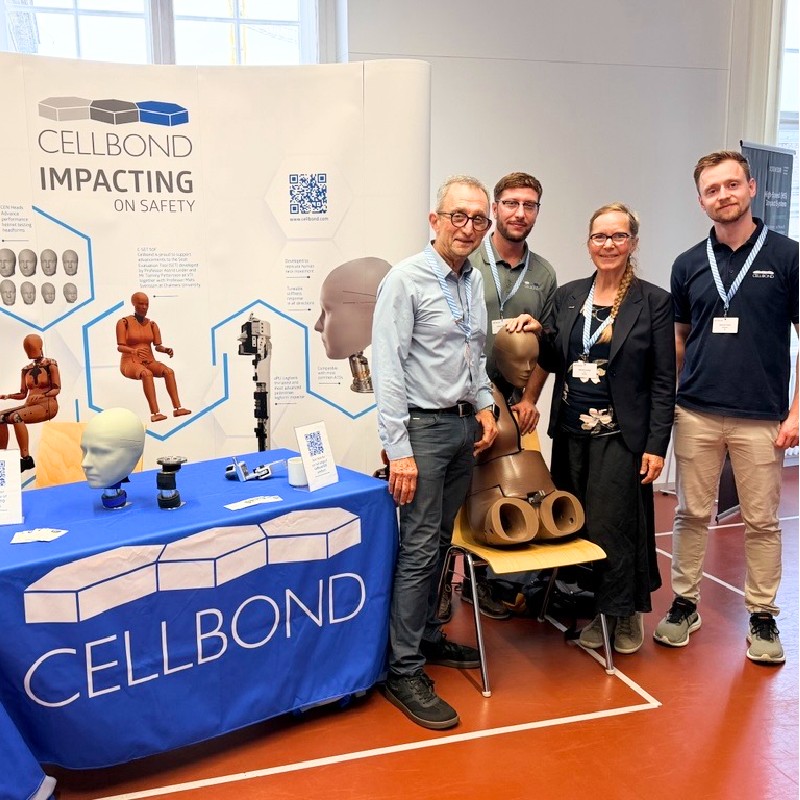
Cellbond has built its own version of the CSET50F, developed by Professor Astrid Linder at VTI, and is working towards bringing it to market alongside a male counterpart, the CSET50M.
For decades, crash testing has relied mainly on dummies based on the average male body. As a result, vehicle safety systems have not always been evaluated for how they protect women, who differ from men in height, weight, body proportions and how their bodies respond in a collision.
Professor Astrid Linder, a researcher at the Swedish National Road and Transport Research Institute (VTI), has been working to address this since the early 2000s. Her research led to the SET50F, the world’s first crash test dummy representing an average-sized woman. SET stands for Seat Evaluation Tool, and 50 refers to the median height, weight and proportions of real women.
The SET50F attracted considerable international attention when it was presented at a road safety conference in autumn 2022. That same year, the BBC named Professor Linder one of its 100 most influential and inspiring women of 2023 in recognition of her work.
From research to production
Cellbond, a leading global manufacturer of crash test equipment, is now building its own CSET50F demonstrator. In September 2026 it was presented at IRCOBI, the international conference on the biomechanics of injury, where Professor Linder met with the Cellbond team. A demonstrator of the male equivalent, the CSET50M, is also being built. Other manufacturers are also developing versions of the dummy.
“We are proud to contribute to translating this pioneering work into a practical solution for the global automotive industry,” says Mike Ashmead OBE, founder and chairman of Cellbond.
Next step: evaluation by the industry
The demonstrators will now be offered to vehicle manufacturers, crash laboratories and road safety organisations for evaluation, with the long-term aim of commercialising the product.
“The aim is to give the industry and testing organisations the opportunity to familiarise themselves with the new tools and to provide feedback for further development,” says Professor Linder.
Interest is growing among international crash safety organisations in using the new equipment, which Professor Linder describes as very encouraging. “That’s the goal of our research, that it really gets to be used,” she says.
For more on the development of the SET50F, read VTI’s full article here: Decades of research lead to industrial breakthrough – vti.se
To enquire about the CSET50F, please contact Oliver Khabiri or a member of our sales team.